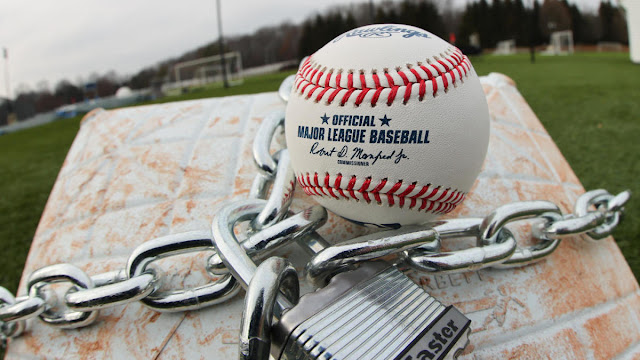
Who am I?

I'm from Houston, a graduate of the University of Texas, a fan of the Houston Astros and Houston Texans. But this blog will be about the "greater sports", whatever that means.

Follow me on Twitter: @lhd_on_sports

Labels

LHD_PotW (738) MLB (205) NFL (176) NCAA (139) NFL Playoffs (78) NBA (77) NHL (68)
Showing posts with label Rob Manfred. Show all posts

Sunday, February 26, 2023

2023 MLB Rule Changes. Is it the end of the beautiful game?

The only thing that is inevitable in life and sports is change.  While conservative (read old school, traditionalist) fans lament anything not like the last.  There is room for improvement in the game in any sport.  But baseball has traditionally been the slowest to move.  With Commissioner Rob Manfred, that has been accelerated with a hyper focus on reducing game length.  Whether shorter games are a desire for fans is in the eye of the beholder.  While 2023 seems like an anomaly in terms of drastic rule changes we've had a number in recent years and this really is just the latest wave.

The lates includes universal DH starting in 2022, COVID introduced but Commissioner kept extra inning ghost runners to speed up the game (and reduce pitcher wear), three batter minimum for relievers (to reduce game time), and limited mound visits introduced in the last 5 years.  In years past, we've lowered the mound (and standardized), allowed instant replay reviews changes of the play (various states of what's reviewable and how it's initiated to include umpire explanations now), changed interference rules for double players, changed blocking home plate rules, implemented pitcher inspections for grip, changed rules for what players could do for watching in game replays, a lot of things.

Baseball Commissioner Rob Manfred has made decisions and many fans aren't happy

But it seems like this year's changes seem to cut at more of the fundamentals of baseball.  Baseball is not supposed to have a clock.  The bases have been the same size for a century.  Defenses being able to position where they want is strategy.  Pitchers throwing to a base when desired is just part of it.  Let's break down the impact of the new rules.  It may not be what you think.   Here is from most impactful to least impactful:

1) Limited throws to first base

  • Pitchers are limited to two disengagements (pickoff attempts or step-offs) per plate appearance. However, this limit is reset if a runner or runners advance during the plate appearance.
  • If a third pickoff attempt is made, the runner automatically advances one base if the pickoff attempt is not successful.
  • The bases, which traditionally have been 15 inches square, will instead be 18 inches square. Home plate is unchanged.


While the throw to first lacked results, it kept runners in check

To me this is the biggest change.  The steal a base you need to take a lead with the peril of a pitcher keeping you close.  After a couple of unsuccessful tries, no longer is that threat in play.  Combined with pitch clock timing and easier bases to get to or from, this fundamentally changes strategy.  Pitchers can also no longer use a "B" move to set up the runner for their "A" move.  The base runner is now apt to take bases at a rate of at least 2 to 1 from prior years (stats will tell).  I grew up in an era in which big time baserunners like Rickey Henderson and Vince Coleman were automatic doubles so that part goes back to the past and an era I enjoy.  But to artificially tilt the table seems unnecessary.  The guise seems to be to limit thrown to first and step offs.  This is a minor contributor to game length.  I think this is the biggest fundamental change of all.

Does Longhorndave (LHD) like this: No
Does LHD think this is good for the game: No

2) Larger bases
  • The bases, which traditionally have been 15 inches square, will instead be 18 inches square. Home plate is unchanged.

Much more real estate to be safe

This has some pros and cons.  Start with the pros.  More room at 1B for reduced unnecessary contact between the first baseman receiving a throw and a runner hitting the corner.  Also, more room for a runner to hit the base and stay on, I for one am not a fan of a runner being out for hitting a base before a tag, however being caught with a toe or finger off the bag.  More room for a middle infielder to avoid perilous contact.  Con is six inches closer to a stolen base.  Three inches on getting back on what is now a limited pick off.  Three inches closer on the SB.  Opens the aperture for SB's a lot.  Gas on the fire of more SBs which fundamentally changes everything.

Does LHD like this: No
Does LHD think this is good for the game: Neutral

3) Limited shift
  • The four infielders must be within the outer boundary of the infield when the pitcher is on the rubber.
  • Infielders may not switch sides. In other words, a team cannot reposition its best defender on the side of the infield the batter is more likely to hit the ball

Student Body Right is no longer allowed


This to me is fool's gold.  The perception that hitters are significantly handicapped by the shift is more legend than reality.  If you ask a player how many hits got taken away by the shift a year they'll answer 20+.  I've heard experts say it's 5 or 6.  That's one a month.  You think every time the ball is hit to the shift OF guy it's a hit.  But the defense might have been there.  Also minus hits against the shift.  Also, pitchers would throw inside into the shift.  Now they are freed to work the outside of the plate.  This will do a bit for BABIP but when balls aren't put in play (historic strikeout levels) is going to be in the noise.  

Does LHD like this: No
Does LHD think this is good for the game: No

4) Pitch clock
  • The pitcher must begin his motion to deliver the pitch before the expiration of the pitch timer.
  • Pitchers who violate the timer are charged with an automatic ball. Batters who violate the timer are charged with an automatic strike.
  • Batters must be in the box and alert to the pitcher by the 8-second mark or else be charged with an automatic strike.
Large counting down digits are here to stay in baseball

If internet anger is to be believed this is the most egregious of them all.  How dare we have a clock in baseball?  How dare we award balls/strikes for violations?  Let me talk you back from the ledge.  Clocks have quietly introduced into the game the past few years between innings (forcing the pitcher to get his butt out to the mound) and for mound visits (reducing the classic stall to get a reliever warmed up).  This pitch clock has been implemented in the minor leagues for a couple of years with no major impacts.  Now, this is a two "step function" change to the game but the reduction in unnecessary game length may be worth the squeeze.  Most of the current length of game delays were simply head play.  Pitcher waiting.  Waiting.  Waiting.  Step off.  I got you batter now you're not ready.  Batter steps out.  Adjust gloves, mental clear.  Make that pitcher wait.  No value for fans.  I'm not a fan of a clock but given other MLB toothless initiatives (like making the batter have a foot in the box with no recourse) this forces a needed element.  I'm not a fan of a clock.  At all.  But am willing to let this play out.  While I expect to see some key ball/strike calls in Spring Training, rest assured after a six-week training of limits players won't push this in key situations after the All-Star Break.  The stakes are too high.  Related, you probably drive 5 MPH over the speed limit.  Right past a cop.  They don't bat an eyelash.  If there was a system that automatically sent you a ticket if you went 1 MPH over and deducted it from your bank account instantly I'm guessing, you'd quickly adjust to go 5 MPH UNDER the speed limit.  Very quickly.  First week you might get caught once or twice.  Won't happen again.  Pitchers are going to be happy they can dig in and get to work.  Batters are most impacted as many use/need that time to clear their head (seems like early they've been the most violations).  They need to adjust to just take the pitch, pause, get back in.  This is where we're at least seeing big gains unlike the other three and it won't be long until this is normalized.

Does LHD like this: No
Does LHD think this is good for the game: Optimistic

What I think the result will be.  Shorter games.  MUCH shorter games.  Disagreement over whether that's good but I'm okay once normalized.  Lots more stolen bases.  Lots more.  Not much in terms of the shift as outlined above.  More eye candy.

In summary, is this a lot of changes, yes.  Have we also seen a number of changes in years prior, also yes.

Tuesday, March 8, 2022

The 2022 MLB Lockout. How did we get here?

The 2022 MLB Lockout has Rob Manfred's name all over it.

I typically stay out of the business side of sports.  If anything, I have a more pragmatic side than most fans.  Example, when someone on your team (e.g. Albert Pujols) that you belove is at a priced out of the value point, your team is better off to let him or her go (e.g. St. Louis Cardinals).  Fans scream "how could you."  I scream, "you had to."

For the unfortunate and, in my opinion, avoidable 2022 MLB lockout, I don't blame owners or players for fighting to maximize their profit from the game, that's what they should do.  Owners have the right to lock out and cancel games as leverage.  Honestly cancelling games has been a single thing that has brought about progress.

But players have the right to not agree to things they think is unfair (early career salaries, a de facto cap, manipulating player seniority) and wait them out.  They are the stars and should get a good portion of the proceeds.  So let's get past taking sides.

The rub is that it comes at the expense of the source of revenue and there is collateral damage.  The fans.  Each of the professional sides is calculating that damage and using it as a bargain to gain leverage instead of treating it as an eroding commodity.
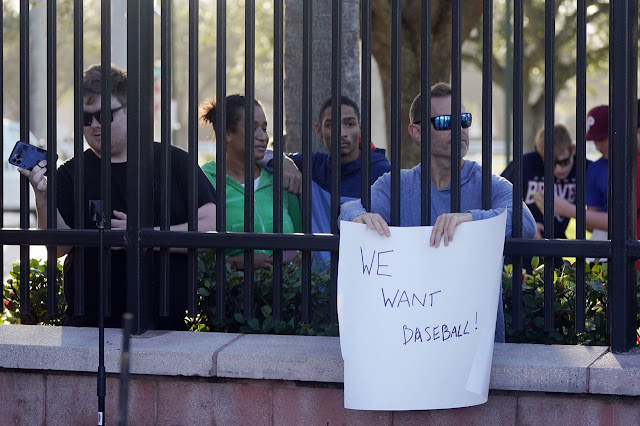
MLB Fans Patience is being tested.  Again.

In other words, owners think players surely have to concede because they don't want to appear as petulant and probably need the income.  We can wait them out.

Players think, no way owners can keep this up, they look horrible.  Especially if we tweet about it a lot. Look a Twitter poll favors us. They'll cave.

And here we are.

The overall negotiations are toxic.  I recall it was described by media as relatively negotiable issues (dividing up slices of the pie, not fundamentally changing the state of the game) coming into it.  Nothing like 1994 in which there were chasms to bridge (drug testing, a recent collusion conviction, etc.).  But now, we're talking universal DH, raise the minimums and caps, then sort out minor details like size of bases and playoff teams and pitch clocks in the process.  Then as things progressed, it just seemed to spiral downward and it was baffling.

I blame Rob Manfred.

Not necessarily because as the owners' negotiator he's not been giving a reasonable deal I'm not counting dollars.  In fact, there were times the owners would move the needle and the players would just walk away without further discussion "unimpressed".  As if they were entitled.

I blame Manfred for the tone of these negotiations.  A leader leads by getting his point across firmly, but listening and making the other side feel heard.  Finding ways to make sure things move forward.  I've heard nothing but the opposite.  We take one step forward and three steps back because players feel mistreated and unheard.  It's on him to ensure that doesn't happen.
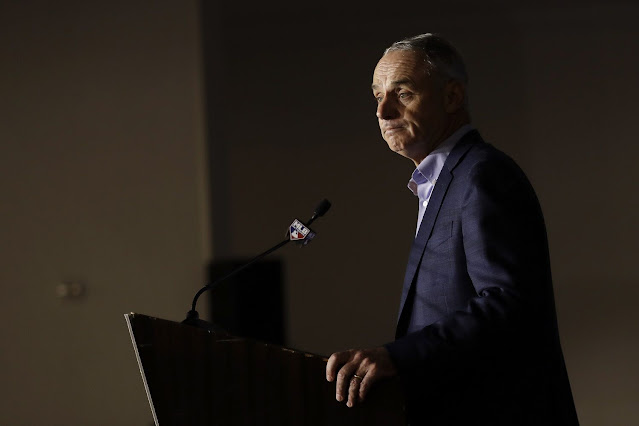
MLB Commissioner Rob Manfred has failed the game

There were ways to approach this in which the tone of the negotiations were set prior to a head.  Set the stage with "here's the things we're thinking, what are you thinking?"  Okay, let's put that aside and get to the numbers later.  Instead it seemed like Manfred just thought they would come in with the rule of law and players would have to agree.  Nope.  And players were right to stand up.  He's really failed the owners.

A good leader removes barriers to ensure customers get their product and Manfred has done the opposite.

As I said, I don't care who gets the bigger piece of the pie.  They'll both get pie.  I just want there to be a pie.  It's the commissioner's job to ensure it happens.  And he's failing.  Miserably.